Door security: the complete guide
Door Strike Plates: The Tier 1 Door Upgrade
Why reinforced strike plates and 3-inch screws change the load path during a kick-in — sourced product picks, DIY instructions, Quebec retail availability.
Updated 2026-04-25
Why the strike plate is usually the weak link
The lock is rarely the first component that fails during a forced entry. The vulnerable point is the small strike plate held by short screws into soft jamb wood. When a kick drives the deadbolt sideways into the strike, screws that anchor only into trim and jamb tear out, and the door opens within a few attempts. The lock holds. The frame does not.
Consumer Reports found that switching to a reinforced box strike with longer screws materially improved kick-in resistance across every lock they tested[1]. That single change is the highest-return upgrade available on most Quebec homes.
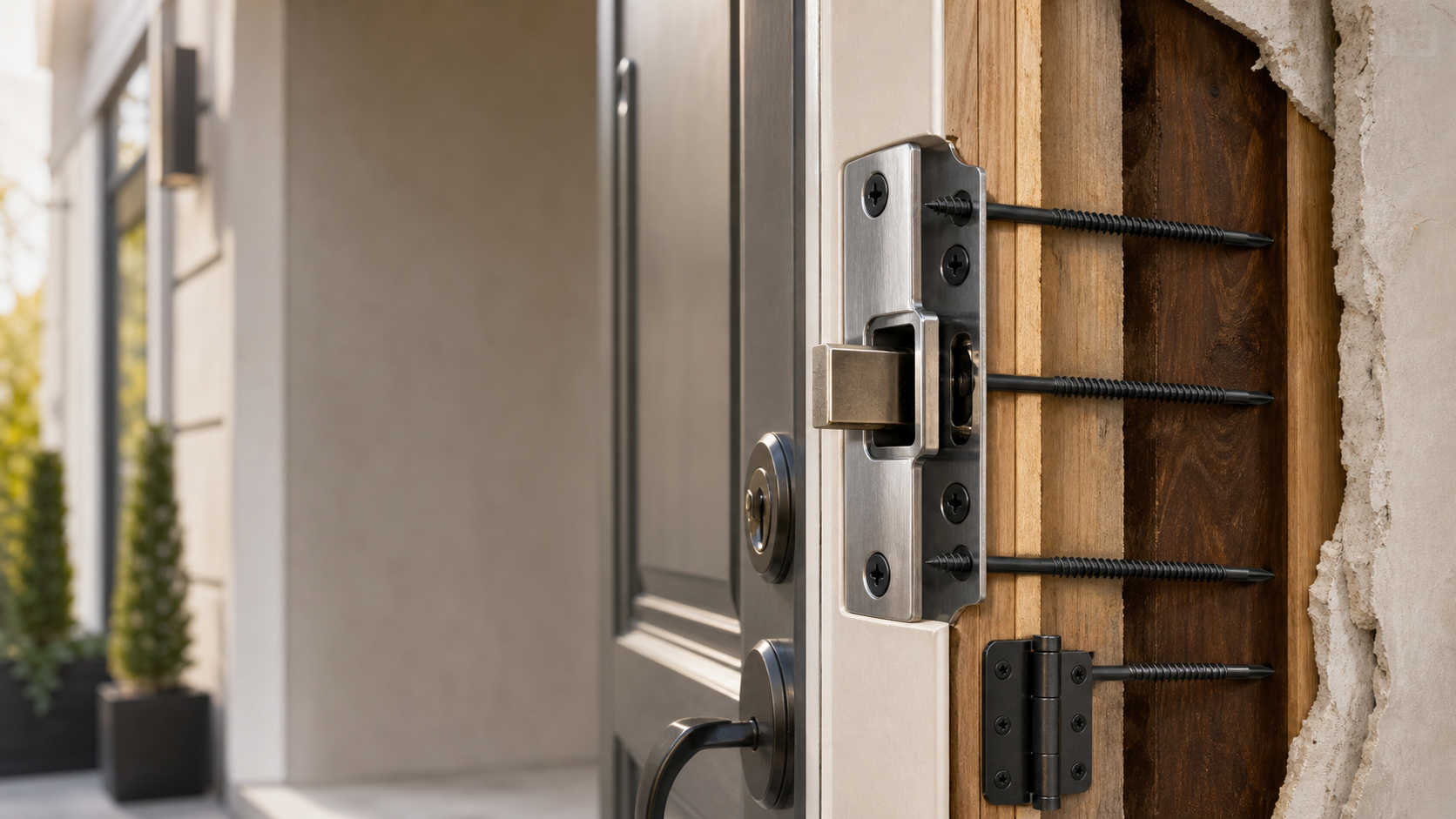
The physics of the failure
A door behaves as a lever during a kick. Force applied near the lock side transfers through the deadbolt as the pivot point. Short screws concentrate that load in a small patch of brittle wood. Long screws spread the same load into the structural framing member behind the jamb.
The hinge side also matters because a door twists under impact. When only the lock side is upgraded, the load can shift to the hinges or split the door edge. For that reason, the recommended upgrade includes one long screw per hinge in addition to a larger strike plate.
Inspect your door in 5 minutes
Open the door and inspect the deadbolt strike.
- If the existing screws are shorter than 1.5 inches, replace them.
- If the strike is a thin decorative plate, upgrade it.
- Confirm that the deadbolt enters the strike cleanly when the door is closed. Adjust first if it does not.
- Inspect each hinge and confirm that at least one long screw per hinge reaches the stud.
- Repeat the inspection on every exterior door, including side, garage, basement, and patio-adjacent.
Audit your home in 5 minutes
Get a score, your top 3 priorities, and a map of the threats you are protected against.
DIY installation
- Use a reinforced box strike or long combination strike plate.
- Pre-drill pilot holes so older jambs do not split.
- Drive 3-inch structural screws. Longer is acceptable; shorter is not.
- Replace one screw per hinge with a 3-inch screw that reaches the stud.
- Verify that the door still latches and deadbolts fully without rubbing.
Avoid over-driving screws to the point that the jamb bows. A bowed jamb reduces bolt engagement and undoes the upgrade.
Ranked product picks
Ranked picks
Best budget strike-only upgrade found at Canadian retail. It follows the box-strike/long-screw pattern Consumer Reports found valuable, but it does not protect the hinge side or door edge.
- Price:
- $10-$20
- Certification:
- No ANSI/BHMA retrofit-kit certification found
- Two-piece strike
- 1/8 inch heavy-gauge steel base
- Pilot holes for 3 inch screws
A stronger choice when the latch and deadbolt spacing matches. The six long screws make it more frame-oriented than cosmetic strikes.
- Price:
- $15-$30
- Certification:
- No ANSI/BHMA retrofit-kit certification found
- One-piece latch/deadbolt combo strike
- For 5-1/2 to 6 inch hole centers
- Six 3 inch screws
StrikeMaster II Pro
A long-plate specialty strike with a better load-distribution concept than small strikes. Evidence is mostly manufacturer/spec and security-community recommendation, not a public lab certification.
- Price:
- $60-$120 landed estimate
- Certification:
- No public ANSI/BHMA retrofit-kit certification found
- Long strike reinforcement plate
- Designed to distribute force along the jamb
- Often paired with door-edge reinforcement
A Canadian retail strike option for compatible jambs. It is useful when the door prep fits ASA dimensions, but it has less product-specific testing evidence.
- Price:
- $10-$25
- Certification:
- No ANSI/BHMA retrofit-kit certification found
- ASA-style strike
- Stamped steel
- Long screw installation
A latch-side upgrade for doors where latch engagement matters, but deadbolt reinforcement remains the more important forced-entry upgrade.
- Price:
- $10-$25
- Certification:
- No ANSI/BHMA retrofit-kit certification found
- High-security latch lip strike
- Stamped steel
- Long screw installation
Two Post Strike Plate
Interesting concealed strike concept, but product-specific independent testing was not found.
- Price:
- $90-$120
- Certification:
- No public ANSI/BHMA retrofit-kit certification found
- Concealed two-post reinforcement
- Designed to anchor into framing
What this upgrade does not cover
A reinforced strike makes the lock-side frame substantially harder to kick in. It does not protect the hinge side, the door edge, or glass beside the door. When the door has been kicked before, when the frame is cracked, or when it guards a hidden entrance, the appropriate next step is a full door reinforcement kit.
Need a pro to install this?
SecureDoor installs door reinforcement across the region. Take 60 seconds to message us.
Or call: (514) 928-8572
Audit your home in 5 minutes
Get a score, your top 3 priorities, and a map of the threats you are protected against.
Need a pro to install this?
SecureDoor installs door reinforcement across the region. Take 60 seconds to message us.
Or call: (514) 928-8572