Window security: the complete guide
Security Window Film: Thickness Is Only Half the System
Why 8-mil film, edge attachment, and frame condition matter more than generic security-film marketing — sourced product picks, professional vs DIY, Quebec install notes.
Updated 2026-04-25
What security film does and does not do
Glass is the bypass route on many homes. A reinforced door is irrelevant if a ground-floor pane beside it can be broken in seconds and the intruder reaches through to the thumbturn.
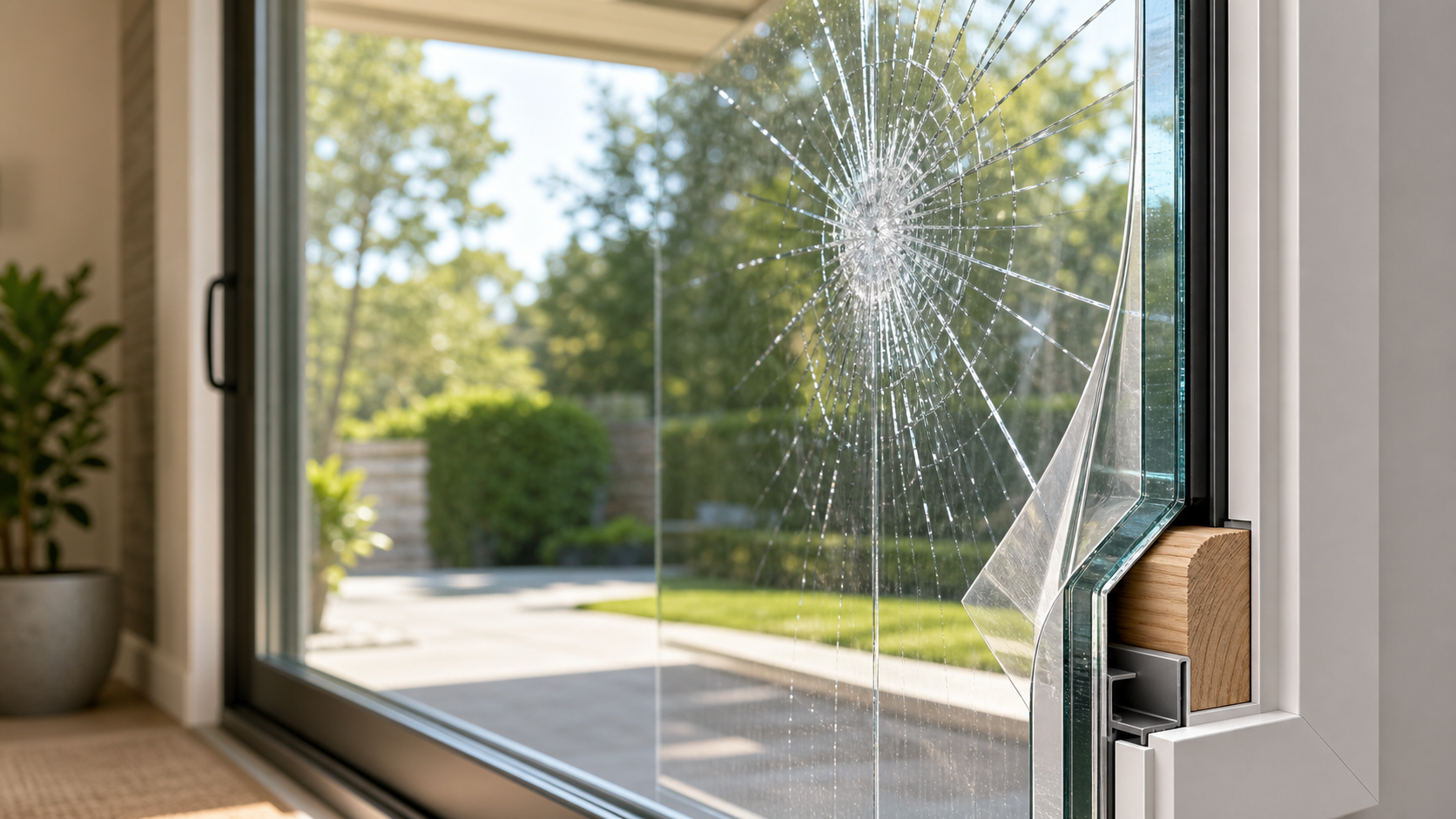
Security film is not a glass replacement. It is a load-transfer layer. The glass still breaks. The film holds the broken sheet together and attached to the frame long enough to make the attack loud, slow, and visible. That delay is what discourages most opportunistic intruders.
Thickness: the unit is "mil," not millimetres
A "mil" is one-thousandth of an inch (0.025 mm), not a millimetre. A 4-mil film is 0.1 mm thick; a 14-mil film is 0.36 mm thick. The numbers sound similar, but performance under impact differs substantially.
| Thickness | Category | Forced-entry relevance |
|---|---|---|
| Under 4 mil | Solar / privacy | No meaningful impact resistance |
| 4–6 mil | Safety film | Holds glass after accidental breakage; minor delay |
| 8 mil | Entry-level security film | Minimum for genuine forced-entry resistance |
| 12–14 mil | Professional security film | High-threat residential and commercial |
| 20 mil and up | Attack-resistant | Institutional and embassy use |
Industry-standard brands tested to ANSI Z97.1 include 3M Scotchshield (S800, S140), Solar Gard Armorcoat, and LLumar Safety & Security (PS8, PS13). These are the products professional installers specify when they refer to "security film."
The anchoring method is what matters
Thickness is necessary but not sufficient. The film must be mechanically attached to the frame.
Daylight cut is incorrect for security applications. The film is cut to the glass size and applied to the glass only. When the pane breaks, the filmed sheet can push out of the frame intact because the film has no structural connection.
Edge attachment is the correct method. The film extends past the glass edge and is tucked under the glazing bead — the narrow trim that holds the glass in the frame. A compatible structural sealant bonds the film to the glazing bead all the way around. When the glass breaks, the load transfers through the film to the frame.
When an installer offers daylight-only installation and describes it as security film, that is the relevant signal.
DIY installation guide
- Clean the glass thoroughly. Any debris under the film remains permanently visible.
- Cut the film to extend past the glass edge by 4–5 mm on all four sides — enough to tuck under the glazing bead.
- Spray the glass with application solution (water with a drop of dish soap).
- Apply the film and squeegee from the centre outward, removing all bubbles.
- Tuck the film edge under the glazing bead with a smooth flat tool — firm enough to seat the film, not sharp enough to cut it.
- Apply edge sealant along the glazing bead joint all the way around.
- Allow 24–48 hours to cure.
For large panes, doors, sidelights, or more than four windows, professional installation is usually the right call. Edge attachment is more consistent and typically comes with a warranty.
Verify egress before installing on any bedroom or basement window. Quebec building code requires egress windows to maintain a clear opening area. Adding film does not reduce the opening, but adding hardware such as stops or locks can.
Ranked product picks
Ranked picks
Best professional-grade 8 mil film candidate. The key message is that forced-entry resistance depends on proper attachment to the frame.
- Price:
- Quote only; commonly professional-installed
- Certification:
- 8 mil film; test claims in 3M data sheet; attachment required for break-and-entry applications
- 8 mil clear multilayer film
- 3M IDs include 7100042604/605/607 depending roll width
- Compatible with 3M Impact Protection Attachment system
Thicker 3M option for higher-risk glass, but the content should call it S140, not S1400, unless a current S1400 source is found.
- Price:
- Quote only; premium professional install
- Certification:
- 14 mil safety/security film; verify project-specific test report and attachment
- 14 mil film
- Professional installation
- Attachment/sealant may be required for security claims
Armorcoat Clear 8 mil
Strong professional-grade 8 mil alternative to 3M, with clear technical tables and dealer network.
- Price:
- Quote only; professional install
- Certification:
- 8 mil clear safety/security film; manufacturer publishes performance and blast docs
- 8 mil clear film
- 88 percent visible light transmittance per Solar Gard table
- Dealer-installed
Armorcoat Clear 14 mil
Thicker Armorcoat option for higher-risk openings, with the same edge-attachment warning as every security film.
- Price:
- Quote only; premium professional install
- Certification:
- 14 mil clear safety/security film; manufacturer performance table
- 14 mil clear film
- 87 percent visible light transmittance per Solar Gard table
SCL SR PS8
Strong tested-film candidate, but use current LLumar product names rather than older shorthand like S80 unless a local dealer confirms it.
- Price:
- Quote only; professional install
- Certification:
- ANSI Z97.1 / CPSC test documentation available in LLumar summaries; verify exact glass/test assembly
- 8 mil product family naming in LLumar documents
- Safety/security and glass retention film
SCL SR PS13
Higher-thickness LLumar contender for exposed glass, with strong test-document support but project-specific verification needed.
- Price:
- Quote only; premium professional install
- Certification:
- ANSI Z97.1 / CPSC test documentation available in LLumar summaries; verify exact glass/test assembly
- Approx. 13 mil safety/security family in LLumar testing summary
- Professional install
Best consumer DIY film found, but it should not be compared directly with professionally attached 3M/Solar Gard/LLumar systems.
- Price:
- $140-$300 depending roll size
- Certification:
- ANSI Z97.1 Class B and CPSC Category 1 per BDF
- 8 mil clear film
- DIY/consumer roll sizes
- Interior application
Canadian DIY availability is useful, but the product needs better test-document support before ranking above BDF or pro films.
- Price:
- $140+ by size
- Certification:
- No independent test report found in quick source pass
- 8 mil film
- Canadian DIY listing
Notable mentions
Best consumer DIY film found, but it should not be compared directly with professionally attached 3M/Solar Gard/LLumar systems.
- Price:
- $140-$300 depending roll size
- Certification:
- ANSI Z97.1 Class B and CPSC Category 1 per BDF
- 8 mil clear film
- DIY/consumer roll sizes
- Interior application
Canadian DIY availability is useful, but the product needs better test-document support before ranking above BDF or pro films.
- Price:
- $140+ by size
- Certification:
- No independent test report found in quick source pass
- 8 mil film
- Canadian DIY listing
Need a pro to install this?
SecureDoor installs door reinforcement across the region. Take 60 seconds to message us.
Or call: (514) 928-8572
Audit your home in 5 minutes
Get a score, your top 3 priorities, and a map of the threats you are protected against.
Need a pro to install this?
SecureDoor installs door reinforcement across the region. Take 60 seconds to message us.
Or call: (514) 928-8572